Emergency Eyewashes and Showers
On this page:
Areas that Require Emergency Flushing Equipment
Suitable facilities for flushing or drenching of eyes and body must be provided within the work area where there is the potential for an exposure to the eyes or body with corrosive or injurious substances.
What is a corrosive substance?
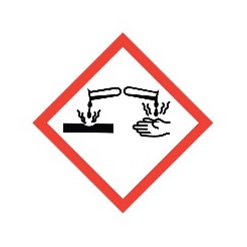
Substances that cause visible destruction of or irreversible alterations in living tissue by chemical action at the site of contact are considered corrosive. Acidic materials with pH less than 4.0 or bases (alkaline) with pH greater than 9.0 are considered corrosive. Common corrosives include strong acids, strong bases, and concentrated solutions of weak acids or bases. There are other compounds that are corrosive to living tissues and are less obvious (Lewis acids, calcium oxide, concentrated hydrogen peroxide, sodium hypochlorite, acid anhydrides, alkylating agents, some organics, etc.). The container label and section 2 of a chemical’s Safety Data Sheet can be used to determine if a chemical is corrosive. Some substances may be classified as acids or bases but their actual level of corrosiveness is low when in contact with the body or eyes and would not be considered likely to cause injuries. These can include hand soaps and some food items like vinegar or lemon juice.
What is an injurious substance?
There are some materials that are not considered corrosive but require immediate flushing to prevent adverse effects to the health and safety of a person. For the purpose of this document, an injurious substance is one that is dangerous by eye or skin exposure. Materials that are absorbed through the skin and can cause additional harm to the body are captured here. For example, methylene chloride and many other organic compounds are classified as injurious by dermal exposure. Other hazards must be evaluated based on their risk of exposure and severity of the consequence (e.g., use of pyrophorics, use of DMSO as a carrier solvent). Potentially infectious materials are considered injurious and must be flushed immediately from eyes (mucous membranes).
-
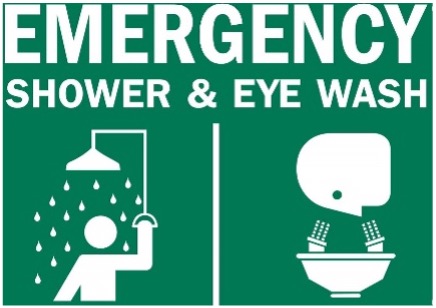
Emergency eyewashes are required in areas where there is a potential eye exposure. These areas include laboratories, chemical storage or mixing facilities, shops, and other areas where these hazardous materials are manipulated. Emergency eyewashes are also required in facilities working at Biosafety Level 2 (BSL2).
-
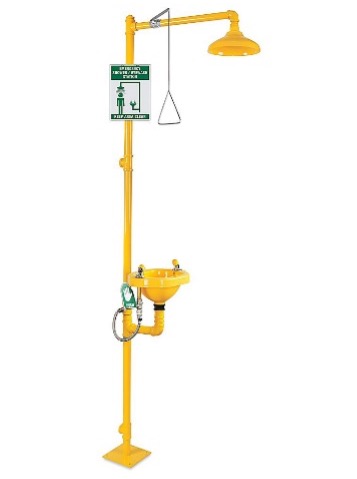
Emergency showers are required in areas where there is a potential for dermal exposure. These areas include laboratories, chemical storage or mixing facilities, shops, and other areas where these hazardous materials are manipulated.
-
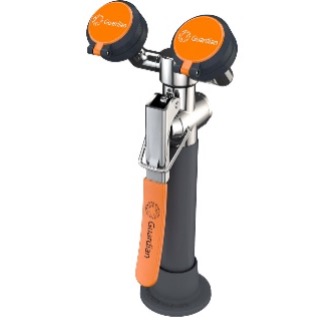
Drench hoses with dual heads can be used as primary eyewash equipment given that it has hands-free stay open valve that activates in one second or less and stays open without the use of operator’s hands until intentionally closed. The dual heads should deliver water flow to both eyes simultaneously. Monocular drench hoses DO NOT meet ANSI standards for emergency eyewash because they are not hands-free.
Drench hoses may be used to "spot" rinse an area when a full shower is not required, to assist a victim when the victim is unable to stand or is unconscious, or to wash under a piece of clothing before the clothing is removed.
-
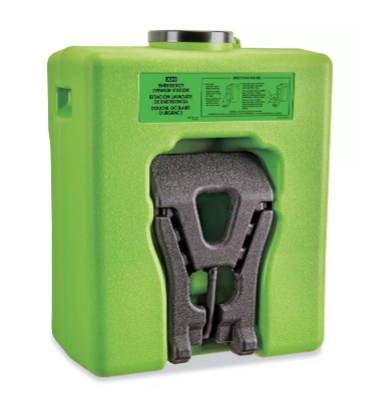
Self-contained eyewashes are discouraged from being installed on campus in lieu of plumbed eyewashes. These units require a weekly visual inspection of the flushing fluid and replacement of the water and solution when it expires, typically every six months. Before purchasing one of these units, contact EHS to determine if this is an appropriate option.
Important Requirements for Eyewash and Safety Showers
- Be accessible within 10 seconds of travel
- Be located on the same level as the hazard
- Be free of obstruction
- Be identified with highly visible signage
- Go from “Off” to “On” in one second or less when operated
- Deliver tepid flushing fluid 60-100o F (16-38o C), for a full 15 minutes
Responsibilities
Environmental Health and Safety (EHS)
- Conducts annual compliance inspections and periodic audits of emergency showers and eyewash stations according to the ANSI Z358.1 Standard and University standards and guidelines.
- Assist with building plan review and selection from a list of recommended equipment during new construction or major renovation.
- Maintain an updated inventory of emergency eyewash and safety shower equipment.
- Approve whether emergency eyewash and shower equipment can be removed from university buildings.
- Provide inspection tags and zip ties upon request.
Principal Investigators and Departmental Units
- Weekly flushing of eyewash units and keeping flushing logs up-to-date and accessible for auditing.
- Provide students and employees with training on location and how to use emergency showers and eyewash stations.
- Submit a facilities workorder of eyewashes or showers that have failed weekly inspections.
- When emergency eyewash stations are not functioning properly, post a sign stating "Out of Service."
Facilities Services and Contractors
- Notify EHS of plans to install, modify, or remove eyewash units or safety showers.
- Assemble and install all units per manufacturer’s instructions. Units shall also meet the requirements of the American National Standard Institute (ANSI) Emergency Eyewash and Shower Equipment Standard Z358.1-2014.
- Provide options for back up eyewash and safety shower capabilities when existing units are out of service.
Maintaining Emergency Equipment
Weekly Activation of Plumbed Eyewashes and Drench Hoses
Plumbed eyewashes must be activated weekly for a period long enough to verify operation and ensure that flushing fluid is available. This helps clean out any rust, scale deposits, or bacteria that may accumulate. This is the responsibility of the occupants of the space. The weekly activations should:
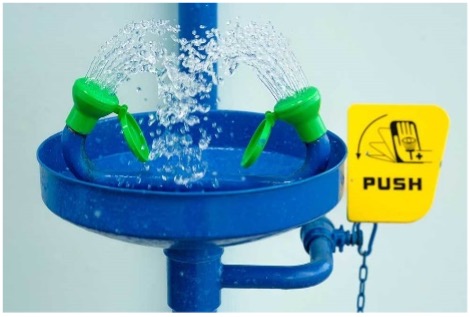
- Ensure that access to the eyewash is unobstructed.
- Visually inspect the eyewash to ensure that there are no broken parts, leaks, etc.
- Verify that protective eyewash covers are properly positioned, clean, and intact.
- Check that the spouts are clean, and the bowl and/or sink drains are free of trash.
- Check that the flow is effective and continuous.
- Maintain an activation log for this weekly inspection on inspection tags. Contact EHS if inspection tags are needed.
- Ensure that problems identified during the activation are resolved as soon as possible. If the unit is found to be non-operational, and there are no other units in the space as back-up, all work with hazardous material that require an eyewash must cease until the unit is repaired.
- If the eyewash fails the inspection, contact EHS at 438-8325 or sysenvironmental@IllinoisState.edu. If the issue requires a plumber, have the departmental facilities coordinator or Building Maintenance Liaison submit a work request to Facilities Services.
Weekly Activation of Emergency Showers
Emergency showers must be activated weekly for a period long enough to verify operation and ensure that flushing fluid is available. This helps clean out any rust, scale deposits, or bacteria that may accumulate. This is the responsibility of the occupants of the space. The weekly activations should:
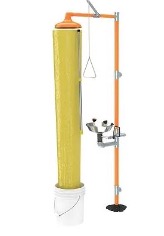
- Ensure that access to the shower is unobstructed.
- Visually inspect the shower to ensure that there are no broken parts, leaks, etc.
- Check that the flow is effective and continuous.
- Maintain an activation log for this weekly inspection on inspection tags. Contact EHS if inspection tags are needed.
- Ensure that problems identified during the activation are resolved as soon as possible. If the unit is found to be non-operational, and there are no other units in the space as back-up, all work with hazardous material that require a shower must cease until the unit is repaired.
- If the emergency shower failed the inspection, contact EHS at 438-8325 or sysenvironmental@IllinoisState.edu. If the issue requires a plumber, have the departmental facilities coordinator or Building Maintenance Liaison submit a work request to Facilities Services.
Weekly Visual Inspection of Self-Contained Eyewash Unit
Self-contained eyewash units must be visually inspected weekly and eyewash solution must be replaced when it expires, typically every six months.
Do not activate the self-contained eyewash units as it will deplete the eyewash solution. This weekly visual inspection should:
- Ensure that access to the eyewash is unobstructed.
- Visually inspect the eyewash to ensure that there are no broken parts, leaks, etc.
- Check that the eyewash is clean and free of trash.
- Determine that the eyewash is still full of water and has not been used.
- Maintain a log for this weekly visual inspection on inspection tags. Contact EHS if inspection tags are needed.
- Ensure that problems identified during the weekly inspection are resolved as soon as possible. If the unit has failed the visual inspection, all work with hazardous material that require an eyewash must cease until the unit is repaired.
- If the eyewash fails the inspection, contact EHS at 438-8325 or sysenvironmental@IllinoisState.edu.
EHS Annual Testing
EHS will conduct annual inspection, testing, and/or maintenance of plumbed eyewashes, emergency showers, supplemental drench hoses, and self-contained eyewashes to ensure conformance with installation and operation guidelines in ANSI Z358.1. Findings will be communicated to the departmental owners, or their designees.
Installing and Updating Emergency Equipment
Emergency showers and plumbed or self-contained eyewashes must meet the following requirements of ANSI Z358.1.
- The equipment is certified by the manufacturer as meeting the most recent edition of ANSI Z358.1.
- The equipment has a controlled flow of flushing fluid that is provided to both eyes simultaneously (for eyewashes), which is not injurious to the user.
- Valves on emergency eyewashes and showers are designed so that the flushing fluid remains on without requiring the use of the operator’s hands. The valve is designed to remain activated until intentionally shut off.
- Emergency eyewash nozzles are protected from airborne contamination. Whatever means is used to afford such protection, its removal will not require a separate motion by the operator when activating the unit.
- The equipment is in unobstructed and accessible locations that require no more than 10 seconds for the injured person to reach along an unobstructed pathway from the source of the hazard. A door in the pathway is considered an obstruction and no new spaces requiring access to the units shall be designed with this obstruction.
- The equipment is located such that accessing the equipment should not require going up and down stairs or ramps.
- The equipment location is identified with a highly visible sign that contains graphical symbols to communicate across language barriers. Signs are white and green to comply with safety instruction and equipment location sign standards (ANSI Z535 Safety Alerting Standards-NEMA, 2011).
Specific Plumbed or Self-Contained Eyewash Requirements
- Eyewashes are installed so that they are capable of delivering to the eyes a minimum of 0.4 gpm (>3.0 gpm for eye/face washes) of flushing fluid for 15 minutes.
- Eyewashes are installed with the water nozzles 33-53 inches from the floor and 6 inches minimum from the wall or nearest obstruction. If they are installed mounted on a counter, they are mounted within 6 inches of the front edge of the lab sink to allow the eyes to be placed in the path of water by simply standing near the unit. There is minimal reaching, bending, stretching or contorting required to reach the eyewash.
- All new plumbed eyewashes have a drain as per the Illinois State Plumbing Code.
- Eyewashes are not to be installed on a faucet spout as per the Illinois State Plumbing Code.
- Eyewashes are installed to meet ADA accommodations where required. ADA accommodations are always required in teaching and instructional spaces (including makerspaces) and in areas where a request for accommodation has been made for a qualified disability. The Office of Equal Opportunity and Access (OEOA) can be contacted to request an accommodation. Contact OEOA at 309-438-3383 or equaloppourtunity@IllinoisState.edu for more information about ADA requirements and installation guidelines that are different from those listed above.
Specific Emergency Shower Requirements
- Emergency showers are installed so that they are capable of delivering a minimum of 20 gpm of flushing fluid for 15 minutes.
- Emergency shower heads are designed so that a flushing fluid column is provided not less than 82 inches and not more than 96 inches in height from the surface on which the user stands.
- The shower head is not mounted flush or recessed with any constructed surfaces or partitions, and the center of the spray pattern should be located at least 16 inches from any obstruction.
- The spray pattern shall have a minimum diameter of 20 inches at 60 inches above the surface on which the user stands.
- All new plumbed and self-contained emergency showers have a floor drain as per the Illinois State Plumbing Code.
- The manual actuator (triangle pull) is not located more than 69 inches above the surface on which the user stands. The manual actuator is free from obstruction for 18 to 24 inches in most directions.
- Emergency showers are installed to meet ADA accommodations where required. ADA accommodations are always required in teaching and instructional spaces (including makerspaces) and in areas where a request for accommodation has been made for a qualified disability. The Office of Equal Opportunity and Access (OEOA) can be contacted to request an accommodation. Contact OEOA at 309-438-3383 or equaloppourtunity@IllinoisState.edu for more information about ADA requirements and installation guidelines that are different from those listed above.
Reporting and Testing New Installations
EHS must be notified of new emergency eyewash and shower equipment including units installed by Facilities Services and outside contractors. All new emergency equipment must meet the installation and operation guidelines in ANSI Z358.1 and Illinois State Plumbing Code. A full test to determine if it meets these guidelines must be performed after installation. Contact EHS to set up a time to perform this test.
Water Temperature
Tepid water must be supplied to emergency eyewash and shower equipment. Water temperature from 60-100°F is considered tepid. Generally, units without a mixing valve or tepid water loop will not maintain this temperature for 15 mins. This makes it difficult for a person to use the unit for the necessary length of time. Campus units should develop a plan to update older units so they have tepid water.
Units obstructed by doors
According to ANSI Z358.1, doors are obstructions in the path to emergency equipment. If buildings have their emergency equipment in the hallway or behind doors, a plan should be put in place to improve access to the equipment until it can be moved into the required rooms. Installing a closing mechanism that cannot be locked to impede access (i.e., panic hardware) to the equipment is one strategy for temporarily improving access to the equipment.
Recommended Activation Equipment
Emergency Shower Tester Kit is a simple testing tool kit used to check that emergency safety showers are operating correctly by capturing and directing water flow during routine inspections.
FAQs
Can EHS check my eyewash or safety shower for me weekly?
EHS does not have the resources to conduct weekly inspection and testing of emergency eyewash and shower stations throughout campus. It is the responsibility of the departments/units who occupy the space to complete and document weekly flow and/or inspections.
Are personal eyewashes (squeeze bottles) able to be installed in lieu of a plumbed or self-contained eyewash station?
Personal eyewashes do not meet the criteria of plumbed equipment. These units are only supplemental and are meant to provide immediate, on-the-spot irrigation until the individual can access a designated eyewash station.
Some of the emergency eyewashes and showers are located in the hallway. What do I do?
Doors are obstructions in the path to the showers. It is important to improve accessibility to the emergency equipment. There must be a plan in place to improve accessibility to those units.
Can I install an eyewash on a faucet?
The Illinois Plumbing Code specifically states that this is not an option. Section 890.800 Special Fixtures and/or Items Designed for a Particular Purpose. b) Emergency eye wash stations shall not be installed on a faucet spout.
In addition to the information in the plumbing code, most faucet mounted eyewashes cannot be turned on in one motion and can be difficult to set a proper, sustained temperature that is not injurious to the eyes.
Who can install or modify eyewash and shower equipment?
Licensed Illinois plumbers must be used to modify and install equipment on campus.
What if I need inspection tags and zip ties, or have more questions?
Call EHS at 438-8325 or email sysenvironmental@IllinoisState.edu.
Definitions
Combination unit – A unit that has a combination of an emergency shower and an eyewash.
Drench hose – A supplemental device consisting of a flexible hose connected to a flushing fluid supply and used to irrigate and flush face and body areas.
Emergency shower – A device specifically designed and intended to deliver flushing fluid in sufficient volume to cause that fluid to cascade over the entire body. Showers shall be capable of delivering flushing fluid at a minimum of 20 gallons per minute.
Personal eyewash – A supplemental device to plumbed or self-contained eyewashes, which can deliver immediate flushing fluid to the eyes or body. These do not replace the need for a plumbed or self-contained eyewash unit that meets the ANSI Z358.1 standard.
Plumbed eyewash – An eyewash unit permanently connected to a continual water supply that is capable of delivering a minimum of 0.4 gallons per minute (gpm) for 15 minutes to both eyes simultaneously at a velocity low enough to be non-injurious to the user.
Self-contained eyewash – A stand-alone eyewash device containing flushing fluid that is capable of delivering a minimum of 0.4 gpm for 15 minutes to both eyes simultaneously at a velocity low enough to be non-injurious to the user.