Peroxide-Forming Chemicals (PFC)
On this page:
What is a PFC?
Some chemicals can form organic peroxides under ambient conditions in the presence of atmospheric oxygen or another oxidizer and an energy source, typically light or heat. These types of chemicals are called Peroxide-forming Chemicals (PFCs), where peroxide refers to an O-O bond. This O-O bond is unusually weak and can be prone to violent decomposition upon exposure to heat, mechanical shock, or friction.
PFCs are strongly recommended to be purchased with inhibitors, which slow or prevent the formation of peroxides. Some processes or reactions require high purity, in which case, PFCs can also be purchased without inhibitors.
A PFC Poster is available for download.
How Peroxides Form
Organic solvents (liquids) are most susceptible to auto-oxidation to form peroxides. Solids, such as potassium, can also form peroxides, though the process is typically much slower. Gaseous PFCs typically do not form peroxides unless they become condensed into the liquid phase or upon transfer from original to secondary container.
The rate of peroxide formation is difficult to estimate, since the O-O bond can decompose to form products that may increase or decrease the rate of peroxide formation.
Factors that affect peroxide formation
- Oxygen: Exposure of PFC’s to oxygen will always enhance peroxide formation
- Time: The peroxide concentration will increase slowly over time. Do not store PFC/s longer than you need to, nor past the timelines indicated for disposal.
- Heat/Concentration: The rate of peroxide formation increases with concentration or the application of heat.
- Light: Ultraviolet light, including sunlight, promotes both peroxide formation and depletion of the inhibitor.
Fun fact: 3 days is enough time for peroxides to form in uninhibited materials
PFC Class Definitions
PFCs are comprised of four classes, A-D. Each class differs in how the peroxides are formed and how reactive the materials become. The recommendations for storage, testing, and disposal differ by class.
| Class A | These PFCs can spontaneously decompose and become explosive upon exposure to air without concentration, even unopened. |
| Class B | These PFCs can form explosive peroxides when distilled, evaporated, or concentrated in other ways. |
| Class C | These PFCs are highly reactive and can auto polymerize and form extremely shock-sensitive and heat-sensitive peroxides. |
| Class D | These chemicals can form peroxides but cannot be clearly classified as A, B, or C. |
Download this list of all PFCs and their classes.
Disposal
PFC waste materials that do not have the PFC label will not be picked up.
- All PFCs should be disposed of as recommended below
- Even if no peroxides are detected, all PFCs should be disposed of as recommended.
- PFCs must be tested on the day you submit a waste pickup request.
- The peroxide concentration must be on the PFC label as well as the pickup request form.
THE PRINCIPAL INVESTIGATOR MAY BE ACCOUNTABLE FOR ALL COSTS ASSOCIATED WITH DISPOSAL IF PFCS ARE NOT SUBMITTED FOR DISPOSAL WITHIN THE RECOMMENDED TIME PERIOD(S)
Please refer to the PFC disposal timelines table below.
Most common peroxide formers on ISU campus and disposal guidelines (not all-inclusive)
| Class | Examples | Disposal – Opened | Disposal – Unopened |
|---|---|---|---|
| Class A – Spontaneous decomposition; explosive in air | Isopropyl Ether (Diisopropyl Ether); Potassium Metal; Sodium Amide | Dispose within 3 months of opening or by expiration date. | Dispose by expiration date or within 1 year of receipt. |
| Class B – Forms peroxides when distilled or concentrated | 1,4 Dioxane; 2-Butanol; Acetaldehyde; Benzyl Alcohol; Cyclohexanol; Cyclohexene; Diethyl Ether; Benzaldehyde; Isopropanol; Tetrahydrofuran (THF) | Dispose within 12 months of opening or by expiration date. | Dispose by expiration date or within 5 years of receipt. |
| Class C** – Polymerizes to form peroxides | Acrylic Acid; Acrylonitrile; Methyl Methacrylate; Styrene | Dispose within 12 months of opening or by expiration date. | Dispose by expiration date or within 5 years of receipt. |
| Class D – Forms peroxides but can't be classified as A-C | 1,2-Dimethoxyethane; Acrolein; Chloromethyl Methyl Ether; Ethyl Vinyl Ether | Dispose by expiration date. | Dispose by expiration date or within 5 years of receipt. |
**Uninhibited Class C PFCs should not be stored for more than 24 hours.
PFC Labels
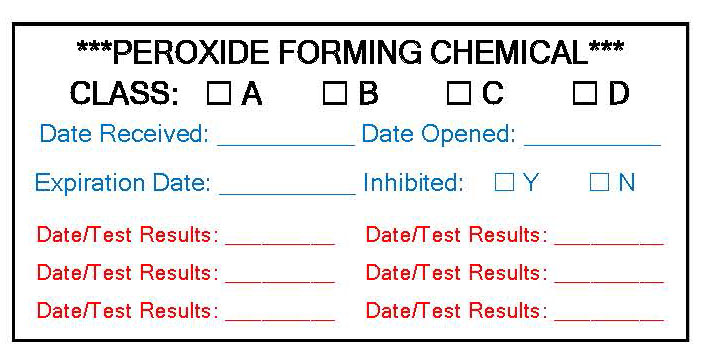
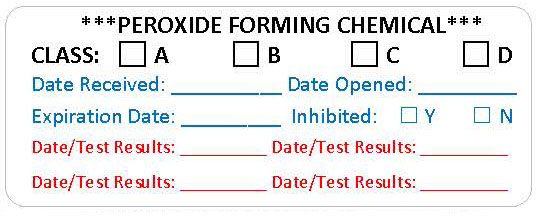
All PFCs should be labeled upon arrival to the laboratory.
Complete all fields on the PFC label:
- Date received
- Date opened
- Expiration date
- PFC Class
Big Labels Avery #5163
Small Labels Avery #5160
Document Testing Details
When testing occurs, document the date and results on the label.
PFC Management
Using PFCs
- First in, first out: Use older chemicals before opening new containers.
- Complete a visual inspection before each use
- Purchase minimum practical quantities so that they are used within the manufacturer’s expiration date.
- Always purchase inhibited PFCs unless your experiment will not tolerate the inhibitor.
- Dispensed solvents from laboratory purification systems do not contain inhibitors and can readily form organic peroxides. Best practices for using these solvents include:
-
Do not dispense more than what will be used during the work period.
-
Dispose of all unused solvents after dispensing.
-
Maintain vigilance for crystal formation, precipitates, or residues.
-
Clean receiving containers thoroughly before re-use.
-
Storing PFCs
Designate a single storage location for all PFCs to avoid “forgetting one.” Follow the recommended guidelines for PFC storage.
Testing PFCs
- Test on a regular basis, as recommended by the manufacturer or the testing for peroxides guidelines.
- Never return decanted reagents to stock bottles.
Disposing of PFCs
- Dispose of all PFCs by the manufacturer’s expiration date or as recommended in the PFC disposal guidelines.
- Contact EHS for disposal of the PFC if it reaches 20ppm.
- Contact EHS if your PFC has visible signs of peroxide formation.
PFC Storage
Always read and understand the Safety Data Sheet before use and storage, and follow the manufacturer’s recommendations.
General Storage Considerations
General considerations for the storage of peroxide-forming chemicals (PFCs) include:
- Apply the peroxide-forming chemical label upon receipt. Note the date of receipt and date of disposal. Once the container is opened, record the date of opening.
- Store in appropriate containers – typically the original container or an amber glass bottle.
- Do not use loose-fitting caps and ground glass stoppers, as these can let oxygen in. Store under an inert gas (check the safety data sheet) when applicable.
- Note: Some phenolic inhibitors for Class C PFCs require oxygen to work. Do not store these under inert atmospheres.
-
Store in a cool, dry, dark cabinet.
-
Low temperatures may cause peroxides to precipitate out of solution, which increases the chances of explosion.
-
Always store liquid peroxides and PFCs above their freezing/melting point. If the manufacturer recommends storing the material in a refrigerator or freezer, ensure that the unit is lab safe or explosion proof and that the temperature is appropriate.
-
Spray bottles and solvent wash bottles that contain PFCs should be emptied when work will be dormant. Consider your usage rate before filling these types of containers, and adjust accordingly to ensure that PFCs are not left sitting out for extended periods of time.
Testing for Peroxides
Learn how to perform peroxide testing using MQuant test strips.
Testing Intervals
Before each use, always perform a visual inspection of any PFC. Perform quantitative testing per the table below.
*Note regarding uninhibited PFCs: When referencing the table below, please keep in mind that more frequent testing is recommended for uninhibited PFCs.
| PFC Classification | Testing |
|---|---|
| Class A | Test within 3 months of opening, or upon expiration. Then test every 90 days if the PFC is retained (not recommended). |
| Class B | Always test prior to concentration or distillation. Test within 12 months of opening, or upon expiration, then test every 90 days if the PFC is retained (not recommended). |
| Class C | Test within 12 months of opening, or upon expiration, then test every 90 days if the PFC is retained (not recommended). |
| Class D | Test within 12 months of opening, or upon expiration, then test every 90 days if the PFC is retained (not recommended). |
Visual Inspection
If there are visual indicators of peroxide formation, do not touch, open, or otherwise disturb the container (inform all lab occupants of this). Call EHS immediately for assistance.
Before using a peroxide-forming chemical, always begin by checking the date received, date of disposal, date opened, and then proceed with a visual inspection. This can be accomplished by using a backlight or a side light with a non-hazardous light source, such as a flashlight. Visible indicators of peroxide formation in pure/non-contaminated PFCs include:
- Cloudiness
- Precipitated crystal formation appearing as chips, ice-like structures, or solid masses
- Wisp-like structures floating in liquid
- Other visible contamination or unexpected layering- Check around caps/lids
Quantitative testing
Ensure that the type of peroxide test you are using is appropriate for your material (for example, there are dip-strips for aqueous solutions and other kinds for organic solvents). The general peroxide testing procedure is as follows:
- Visually inspect bottle for crystallization (especially around cap or in the liquid), visible discoloration, and/or liquid stratification.
- Use glass pasteur pipet to get small amount of liquid.
- Put drop on square test field on test strip.
- Shake off excess liquid.
- Add one drop of DI water when testing an organic solvent (Do not need to add any water for inorganic solutions).
- Write results on label. Include date, value, and your initials.
- Allow test strip to evaporate, then discard in general refuse.
If you are using the MQuant Peroxide Colorimetric test strips (available through ISU Chemistry Stockroom), always test for hydroperoxides by adding a drop of water to the test strip after the solvent has dried. (This process is noted on the container insert, but not on the container).
- For a dip-strip test, transfer a small amount of solvent to another container. To avoid potential contamination of the chemical, do not dip into the original container unless it is waste.
- Dip strips have an expiration date and must be stored according to the manufacturer’s recommendations.
- Follow the manufacturer’s instructions for completing the test and record the peroxide level, date, and your initials on the PFC label.
- Further actions will depend on the concentration of peroxide.
Peroxide Testing Results
| PPM Level | Action |
|---|---|
| 1 ppm | Okay to keep; Do not concentrate to near-dryness. |
| 3 ppm | Okay to keep; Do not concentrate to near-dryness |
| 10 ppm | Okay to keep, but must now test every month; Do not concentrate to near-dryness. |
| >10 ppm | Get 0-25ppm test strips from Stockroom to get accurate readings; Do not concentrate to near-dryness. |
| ≥20 ppm | 19ppm is the maximum level that the hazardous waste hauler will transport. Combine, bulk, or inhibit/stabilize until ppm is 19ppm or less. Do not concentrate to near-dryness. |
| >20ppm <100ppm | Not recommended for distilling or concentrating. |
| ≥100 ppm | DO NOT USE. Contact EHS for assistance. Additional testing may be required prior to disposal. |
Frequently Asked Questions
Where can I get PFC testing strips?
Do I have to test my unexpired, open PFCs?
Yes
- Unexpired, open containers of Class A PFCs must be tested within 3 months of opening.
- Unexpired, open containers of Class B PFCs must be tested within 12 months of opening AND/OR before concentration/distillation.
- Unexpired, open containers of Class C PFCs must be tested within 12 months of opening.
- Class D PFCS must be tested upon expiration, then at least every 12 months thereafter if not submitted to EHS for disposal (not recommended).
Do I have to test my unopened, expired PFCs?
Yes, unopened PFCs must be tested upon expiration. EHS recommends disposing of expired PFCs.
What do I do if I want to keep my expired PFCs?
EHS does not recommend keeping PFCs past their expiration date (nor past the recommended disposal limit for open, unexpired PFCs). If you decide to keep these PFCs, you must test them at least every 90 days. More frequent testing is recommended.
The Principal Investigator will be accountable for all costs associated with disposal if PFCs are not submitted for disposal within the recommended time period(s).
My test results for the expired PFCs are above 20 ppm. Can I keep them?
Yes, however, there are things to consider:
- How quickly you plan on using up the PFC
- The class of PFC
Keep in mind, to dispose of the PFC, levels must be less than 20ppm. Either the PFC must be entirely consumed or stabilized to <20ppm before disposal. Please reference the “Peroxide Testing Results” table for guidance on safe levels for certain applications.
We have Isopropanol (IPA) in wash bottles that are frequently used. Do I have to test all my IPA wash bottles?
Typically, no, since spray bottles and solvent wash bottles containing PFCs are frequently used, emptied, and refilled. Consider your usage rate before filling these types of containers and adjust accordingly to ensure that PFCs are not left sitting out for extended periods of time. Empty any spray or wash bottles when work is dormant.
I have Class D PFCs. How frequently do I have to test them?
Class D PFCs must be tested upon expiration, then at least every 12 months. Many Class D PFCs are solids, which are difficult to test (dip-strips cannot be used). Thus, EHS recommends disposing of expired solid PFCs. Some visual indications of peroxide formation in solid materials include color and/or texture changes.
How do I test my solid PFCs?
Peroxide testing is tricky for solid chemicals, requiring more time and wet-chemistry methods (dip-strips cannot be used). Thus, EHS recommends disposing of expired solid PFCs. Some visual indications of peroxide formation in solid materials include color and/or texture changes.
I do not see any visual indicators of peroxide formation. Do I still need to test my PFCs?
Yes, use the testing guidelines to test your PFCs based on the PFC class.
I see crystal formation, cloudiness, wisp-like structures and/or other visible contamination in my PFC containers. What do I do?
If you see any of these visual indicators, do not disturb the containers. Contact EHS for assistance. Alert laboratory personnel and post a sign on the storage location informing everyone of potentially explosive peroxides.
I only have a few containers of PFCs that I need to dispose of and don’t plan to get any more. Do I have to buy a whole kit of test strips?
Contact the Chemistry Stockroom for test strips. Either visit the service window at SLB 110 or email chemstock@ilstu.edu.